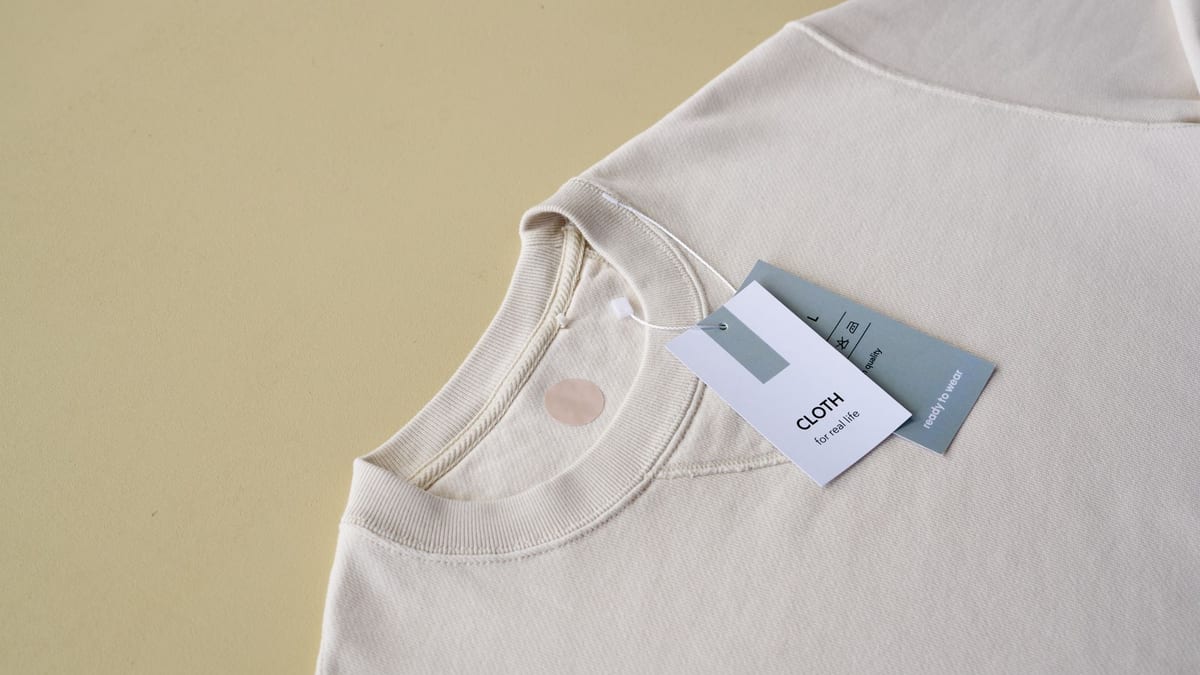
Labelling is the least interesting part of an apparel import and one of the most expensive to get wrong, because the fix is relabelling every unit in a warehouse rather than a conversation with a factory.
Here is the shape of what US requirements cover, and what to ask your supplier.
The four things a label generally carries
For textile apparel sold in the US, labelling requirements are administered by the Federal Trade Commission and cover, broadly:
| Element | What it means |
|---|---|
| Fibre content | What the garment is made of, by percentage of weight |
| Country of origin | Where it was made |
| Company identity | Who is responsible — a name, or an RN number |
| Care instructions | How to clean it without ruining it |
The first three sit under textile identification rules; care instructions are a separate rule with its own requirements. They are usually applied together, which is why they get treated as one thing.
We are a knitwear manufacturer, not a compliance consultancy. Everything here is the shape of the requirement, not the requirement itself. Rules are amended, and your product, materials and channel determine what applies. Confirm current requirements with your own customs broker or counsel before you finalise labelling — the obligation sits with the party placing the goods on the market, which is you rather than a factory abroad.
Fibre content
The principle is straightforward: state what is in the garment, by percentage, by weight, in descending order, using recognised generic fibre names.
So 60% cotton, 40% polyester, not “cotton rich” and not a trade name on its own. If you use a trademarked fibre name, the generic name generally has to appear as well.
Two things that catch people:
- Small amounts still count. The 5% elastane in a stretch tee belongs on the label.
- Trims can be treated differently from the body. Rules on linings, trims and small components are not identical to the main fabric — worth checking with your broker for anything unusual.
Getting this wrong is not only a compliance problem. It is also the number your customs broker uses to classify the goods, and a wrong classification is a duty problem.
Country of origin
Where the garment was made. For a garment cut and sewn in India, that is India.
The rules on what counts as origin when a garment crosses several countries during production are genuinely complicated, and they are your broker’s territory rather than ours. If your supply chain involves fabric from one country and assembly in another, ask them specifically.
Company identity and the RN number
The label has to identify the company responsible for the garment. That can be the company name, or an RN number — a registered identification number issued by the FTC that stands in for it.
Two points that get muddled:
- An RN is optional. A company name works.
- An RN belongs to a US business. Your factory abroad does not have one and does not need one, and if a supplier offers to put “their” RN on your goods, ask what that actually means.
Care instructions
A separate requirement, and the one most often treated as an afterthought.
The garment needs care instructions covering the regular care it needs — washing, bleaching, drying, ironing — and a warning where a reasonable care procedure would damage it. Care symbols are widely used, and there are specific requirements about what has to be conveyed and how.
The practical risk here is not legal. It is that a wrong care instruction produces a garment that shrinks or bleeds in the customer’s machine, and the return comes to you.
What to ask your factory
Five questions:
- Do you apply US-market labelling in the factory, or do goods arrive unlabelled? Relabelling in a warehouse costs more than it sounds and never appears in the quote you compared.
- Can you produce the label artwork to my specification, including my RN or company name?
- What fibre content will you state, and does it match what you are actually knitting? Ask for the yarn specification alongside.
- Are care instructions based on a test, or copied from a similar garment? They should follow from the actual fabric and finishing.
- Can you supply the documentation my broker will want — commercial invoice, packing list, certificate of origin?
Where this sits
Labelling is one of several things that decide whether a shipment moves smoothly, alongside classification, origin documentation and inspection. What an AQL inspection checks includes labelling and packing, so a pre-shipment inspection is the last practical point to catch a labelling error while it is still the factory’s problem.
Children’s garments carry a further set of obligations on top of all this — what CPSIA requires of a US importer is a separate and stricter regime. If you are earlier in the process, the steps for finding and verifying a manufacturer come first — a factory that already ships to the US will have done this before, and that experience is worth something.
We apply US-market labelling in our unit in Tirupur — fibre content, country of origin, your company name or RN, and care labels — so goods arrive ready for your DC rather than a relabelling table. We supply importers and brands across the United States from 300 pieces per style per colour. Send us your label artwork and we will tell you what we need to produce it.
Keep reading
CPSIA and children's clothing: what US importers must check
Children's apparel entering the US carries obligations adult garments do not — testing, certification and tracking labels. What CPSIA covers and the questions to put to a factory.
How to find a clothing manufacturer (without getting burned)
The order of operations that works: define the garment, shortlist factories, verify them, sample, then place a small first order. Written by a factory, including the parts that are not flattering to us.
Children's clothing manufacturers: what to ask before you order
Children's garments carry obligations adult ones do not — cords, trims, labelling and traceability. The questions a UK buyer should ask a factory before placing an order, and what a good answer sounds like.